Table of Contents
ToggleVirtual reality vs augmented reality, two technologies that sound similar but deliver very different experiences. One pulls users into a fully digital world. The other layers digital elements onto the real world. Both have exploded in popularity, from gaming and entertainment to healthcare and education. But which one does what? And more importantly, which suits specific needs?
This guide breaks down virtual reality vs augmented reality in plain terms. It covers definitions, core differences, real-world applications, and how to choose between them. By the end, readers will understand exactly what sets these technologies apart.
Key Takeaways
- Virtual reality (VR) fully immerses users in a digital world, while augmented reality (AR) overlays digital elements onto the real world.
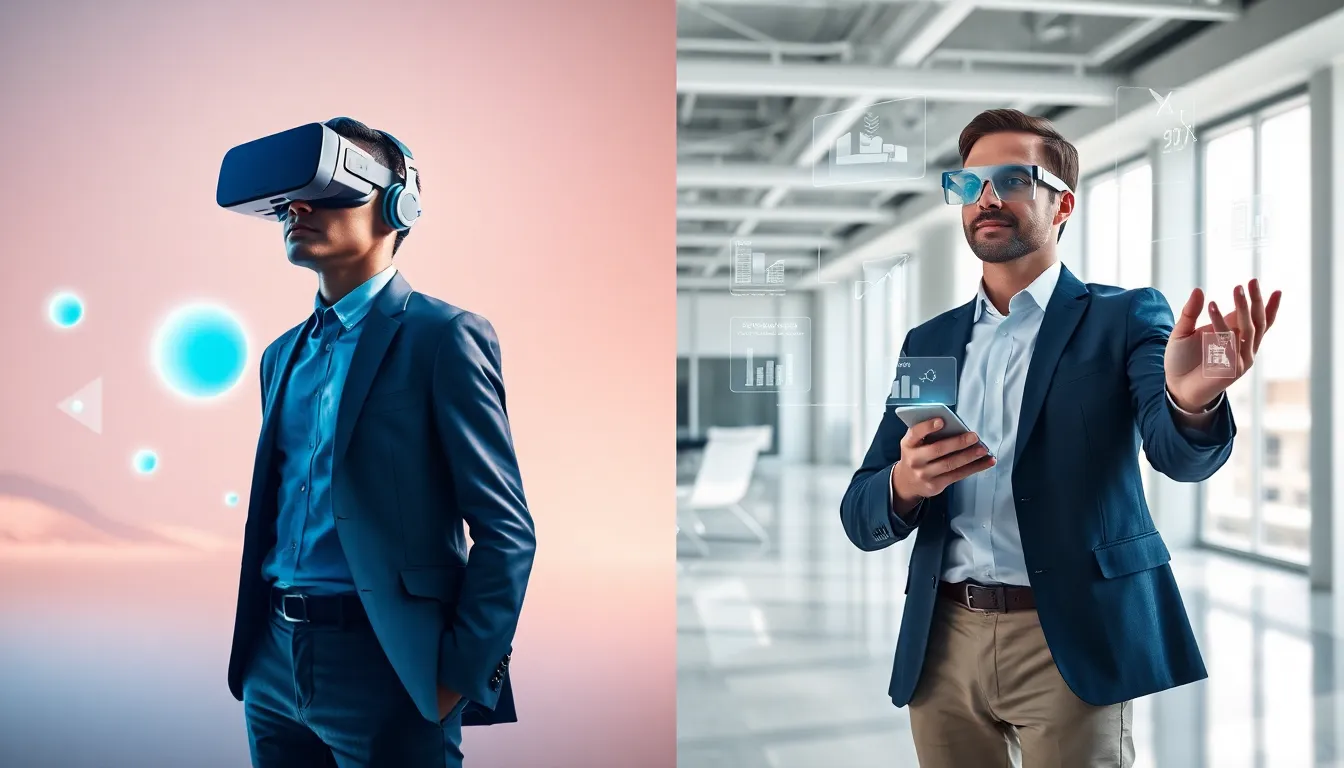
- When comparing virtual reality vs augmented reality, the key difference is immersion level—VR isolates you from your surroundings, AR keeps you grounded in reality.
- VR excels in gaming, training simulations, and therapy, while AR shines in retail, navigation, and hands-on maintenance tasks.
- VR requires dedicated headsets costing several hundred dollars, whereas basic AR works on almost any modern smartphone.
- Choose VR for full immersion and escape-based experiences; choose AR when real-world awareness and mobility matter.
- Mixed reality (MR) is blurring the lines between virtual reality vs augmented reality, with devices like Apple Vision Pro offering both experiences in one headset.
What Is Virtual Reality?
Virtual reality (VR) creates a completely immersive digital environment. Users wear a headset that blocks out the physical world entirely. Everything they see, hear, and sometimes feel comes from the virtual space.
The technology relies on head-mounted displays like the Meta Quest 3, PlayStation VR2, or Valve Index. These devices track head movements and adjust the visual display in real time. This creates the sensation of actually being inside a different place, whether that’s a fantasy game world, a virtual meeting room, or a training simulation.
VR often includes handheld controllers or gloves that let users interact with virtual objects. Some advanced systems add haptic feedback, so users can “feel” textures or resistance. The goal is total immersion. When virtual reality works well, users forget they’re standing in their living room.
The technology has come a long way since early, clunky prototypes. Modern VR headsets offer higher resolution displays, wider fields of view, and better motion tracking. Wireless options have also improved, cutting the tether to a PC or console.
Virtual reality demands significant hardware. A quality headset can cost several hundred dollars, and PC-based systems may require a powerful computer. But standalone headsets have made VR more accessible than ever.
What Is Augmented Reality?
Augmented reality (AR) takes a different approach. Instead of replacing the real world, AR adds digital content on top of it. Users see their actual surroundings with virtual elements layered in.
Smartphones provide the most common AR experience. Apps like Pokémon GO place animated characters in real locations using the phone’s camera. IKEA’s app lets shoppers visualize furniture in their homes before buying. These examples show how AR blends digital and physical spaces.
Dedicated AR glasses offer a more seamless experience. Devices like Microsoft HoloLens and the newer Apple Vision Pro project holograms into the user’s field of vision. The user can walk around a room while digital objects stay anchored in place.
AR doesn’t require the same level of immersion as VR. Users stay aware of their environment. They can interact with both real and virtual elements simultaneously. This makes augmented reality practical for tasks where situational awareness matters.
The hardware requirements for AR vary widely. Basic AR works on almost any modern smartphone. High-end AR glasses, but, can cost thousands of dollars and target professional or enterprise users.
Core Differences Between VR and AR
Virtual reality vs augmented reality comes down to one fundamental distinction: immersion level.
VR isolates users from their physical surroundings. They enter a fully synthetic environment. AR keeps users grounded in reality while adding digital layers. This single difference shapes everything else about these technologies.
Environment
- VR: 100% digital, completely replaces real-world visuals
- AR: Real world with digital overlays
Hardware
- VR: Requires dedicated headsets that cover the eyes
- AR: Works on smartphones, tablets, or specialized glasses
Mobility
- VR: Limited movement: users often stay in one area to avoid bumping into objects
- AR: Full mobility: users move freely while seeing their surroundings
Interaction
- VR: Users interact only with virtual objects
- AR: Users interact with both real and virtual elements
Use Context
- VR: Best for experiences requiring total focus or escape
- AR: Best for enhancing real-world tasks or information
Virtual reality excels at creating presence, the feeling of truly being somewhere else. Augmented reality excels at utility, providing helpful information or visuals in context. Neither technology is inherently better. They serve different purposes.
Common Use Cases for Each Technology
Both virtual reality and augmented reality have found strong footholds across multiple industries. Their applications continue to expand as the technology improves.
Virtual Reality Use Cases
Gaming and Entertainment
VR gaming offers experiences impossible on flat screens. Players can physically dodge, duck, and swing their way through games. Beat Saber and Half-Life: Alyx showcase VR’s potential for interactive entertainment.
Training and Simulation
Military organizations, airlines, and healthcare providers use VR for realistic training. Surgeons practice procedures. Pilots log flight hours. Workers learn dangerous jobs safely. VR training reduces risk and cost.
Real Estate and Architecture
Virtual tours let buyers explore properties remotely. Architects walk clients through buildings before construction begins. This saves time and helps stakeholders visualize final results.
Therapy and Rehabilitation
VR helps patients with PTSD, phobias, and chronic pain. Controlled virtual environments allow safe exposure therapy. Physical rehabilitation programs use VR games to make exercises engaging.
Augmented Reality Use Cases
Retail and E-Commerce
AR lets customers try before they buy. Makeup apps show how products look on faces. Furniture apps place items in rooms. This reduces returns and increases purchase confidence.
Navigation and Information
AR navigation overlays directions onto real streets. Heads-up displays in cars show speed and alerts without drivers looking away from the road.
Maintenance and Repair
Technicians use AR to see step-by-step instructions overlaid on equipment. This speeds up repairs and reduces errors. Companies like Boeing use AR glasses on assembly lines.
Education
AR brings textbooks to life. Students can examine 3D models of molecules, historical artifacts, or anatomical structures. The technology makes abstract concepts tangible.
Which Technology Is Right for You?
Choosing between virtual reality vs augmented reality depends on goals, budget, and context.
Choose VR if:
- The goal requires full immersion or escape from reality
- Training scenarios need realistic, consequence-free environments
- Entertainment and gaming experiences are the priority
- Users can dedicate space and time to wearing a headset
Choose AR if:
- Real-world context matters during the experience
- Users need to stay mobile and aware of surroundings
- The application supplements existing tasks rather than replacing them
- Budget constraints favor smartphone-based solutions
For businesses, the decision often comes down to specific problems. A company training employees on dangerous equipment might benefit from VR simulations. A field service team needing hands-free instructions would find AR glasses more practical.
Consumers typically start with AR because it’s already on their phones. VR requires a bigger investment but delivers more dramatic experiences. Many tech enthusiasts own both, using AR daily and VR for dedicated gaming or creative sessions.
The lines between virtual reality and augmented reality are also blurring. Mixed reality (MR) combines elements of both, allowing virtual objects to interact with real environments. Devices like the Apple Vision Pro aim to offer the full spectrum of experiences in one headset.